
Area Codes Serving Winston-Salem
Winston-Salem is served by the 336/743 overlay complex. The older Winston-Salem area code is 336, which became the Triad code after it split from 910 in 1997. The newer overlay is 743, approved by the North Carolina Utilities Commission as relief for the 336 area. Both codes cover Winston-Salem and Forsyth County, and both are valid local area codes for the same geography.
The NANPA public NPA report lists both 336 and 743 as general purpose North Carolina codes in the 336/743 overlay complex. The North Carolina Public Staff notice explains the practical effect: existing 336 numbers stayed in place, new 743 numbers could be assigned later, and local calls in the overlay area require the area code plus the seven-digit number.
| Area Code | Coverage | Year Assigned | Overlay Status |
|---|---|---|---|
| 336 | Winston-Salem, Forsyth County, Greensboro, High Point, Kernersville, Burlington, Asheboro, Roxboro, North Wilkesboro, and nearby Triad communities | 1997 | Original member of the current 336/743 overlay complex |
| 743 | Same geography as 336, including all Winston-Salem neighborhoods and Forsyth County exchanges | 2014 assigned, 2016 in service | All-services distributed overlay over 336 |
Winston-Salem Area Code Neighborhoods
The Winston-Salem area code map is not a city map split by ward, ZIP, or neighborhood. Downtown Winston-Salem, West End, Ardmore, Buena Vista, Washington Park, West Salem, East Winston, North Winston, Reynolda, Old Salem, Waughtown, Hanes Mall, Silas Creek, and the Winston-Salem State University area are all inside the same 336/743 overlay. The same rule applies to common Winston-Salem ZIPs such as 27101, 27103, 27104, 27105, 27106, 27107, 27127, and 27110.
The North Carolina Public Staff 336/743 map is useful because it shows exchange and county boundaries instead of treating 336 as a single city code. Winston-Salem residents should not assume that 336 means a call came from one neighborhood or that 743 means the call is outside the city. The overlay covers the same local calling area.
The manifest image from the North Carolina Public Staff notice shows the mandatory dialing announcement tied to the Winston-Salem overlay area.
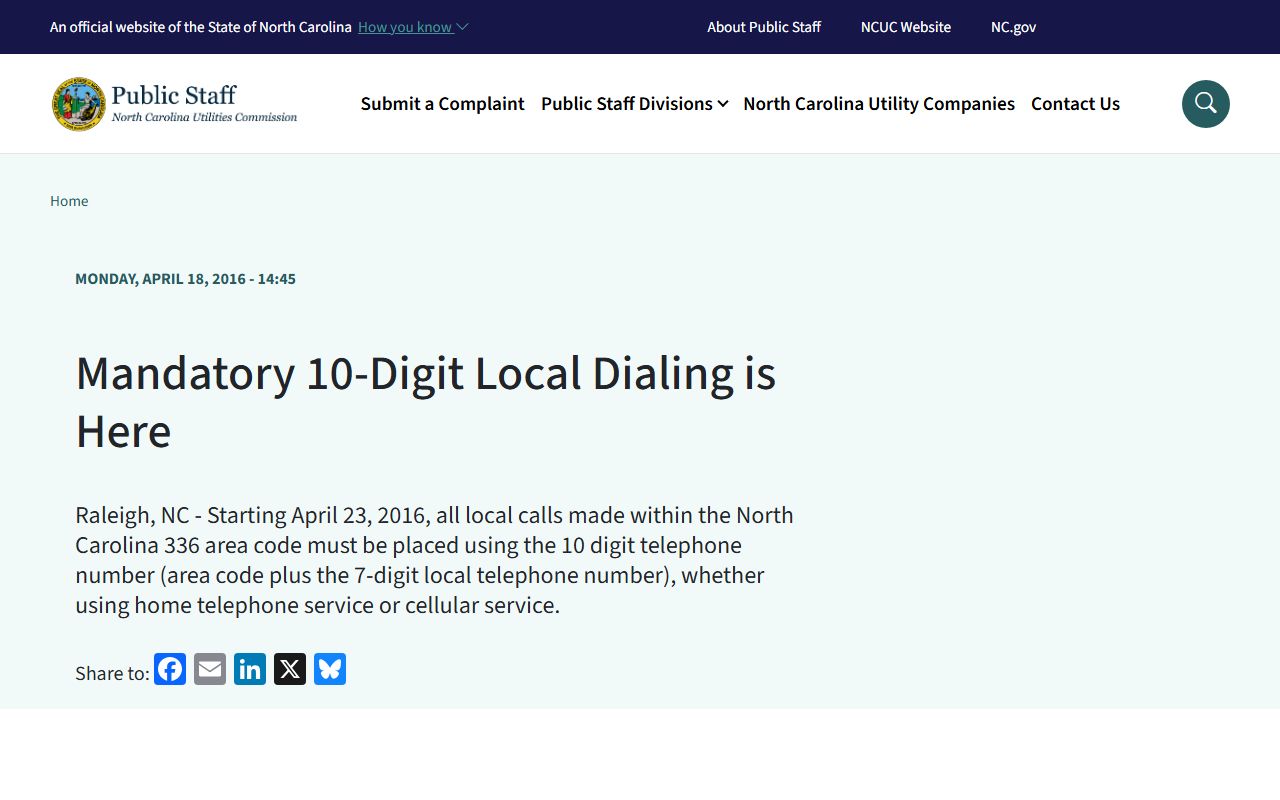
That source supports the key local point: the area code boundary is regional, while the dialing rule applies citywide in Winston-Salem.
- Central Winston-Salem - 336 and 743 share coverage.
- West End, Ardmore, and Buena Vista - no separate area-code boundary.
- East Winston and North Winston - both codes are local.
- WSSU, Old Salem, and Salem areas - the same overlay complex applies.
- Kernersville and nearby Triad communities - also inside the broader 336/743 region.
Winston-Salem Overlay vs Split
Winston-Salem received an overlay, not a geographic split. A split would have divided the 336 territory and forced some customers to move to a new area code. The overlay placed 743 on top of the same territory, which let existing customers keep 336 numbers while new phone numbers could use 743. North Carolina regulators chose that path because it avoided dividing counties and exchange areas.
- NPA
- Numbering Plan Area, the three-digit area code at the start of a North American phone number.
- NXX
- The three-digit central-office or prefix code after the area code, such as the middle three digits in a 10-digit number.
- Overlay
- A new area code added to the same geography as an existing area code.
- Split
- A relief method that divides a region so one part keeps the old code and another part changes.
Note: A 743 number can be a valid Winston-Salem number; scam risk depends on caller behavior and verification, not the code alone.
Winston-Salem Area Code Dialing Rule
Local calls in Winston-Salem must be dialed as 10 digits: area code plus the seven-digit number. The mandatory rule began April 23, 2016, before new 743 numbers could begin assignment on May 23, 2016. Long-distance domestic calls still use 1 plus the area code and seven-digit number when the carrier requires it.
Important: Seven-digit local dialing no longer fits Winston-Salem phone area codes; include 336 or 743 for local calls.
The deeper dialing reference belongs with Winston-Salem phone codes, where N11 service codes, star codes, toll-free prefixes, country code +1, and international dialing are handled as code-use questions rather than map questions.
Winston-Salem Area Code History
Winston-Salem area code history follows North Carolina's larger numbering plan. The state began with 704 as an original North American Numbering Plan code. Later splits added 919, then 910, and then 336. By 2014, projected exhaust in the 336 area led the North Carolina Utilities Commission to approve 743 as an overlay.
| Year | Event |
|---|---|
| 1947 | 704 served as one of North Carolina's original NANP area codes. |
| 1954 | 919 entered service in North Carolina. |
| 1993 | 910 entered service after a split from 919. |
| 1997 | 336 entered service from 910, making Winston-Salem a 336 city. |
| 2014 | NCUC approved 743 as an all-services overlay for 336. |
| 2016 | Mandatory 10-digit local dialing began, and 743 entered service. |
Winston-Salem Area Code Prefixes
The NXX prefix is the three digits after the area code. In the older landline model, NXX prefixes often pointed to a wire center or rate center. In current Winston-Salem phone numbers, they are clues rather than proof. NANPA's central-office file labels the Winston-Salem rate center as WINSTN SAL and, in the 2026 source noted in the research, showed 145 utilized 336-NXX rows and 19 utilized 743-NXX rows for that rate center.
Local patterns still help. City services often use 336-727, 336-734, 336-747, and 336-773 numbers. Forsyth County uses many 336-703 and 336-917 numbers. Wake Forest University uses 336-758; Atrium/Wake Forest Baptist uses 336-716; WSSU uses 336-750; UNCSA uses 336-770 and 336-734. Number portability and VoIP mean those patterns should be checked against the official directory before calling back.
Future Winston-Salem Area Codes
NANPA's public NPA report dated June 29, 2026 confirms the current 336/743 overlay complex and does not identify a new Winston-Salem relief code in service. That means current Winston-Salem area code work should focus on the two active codes and the 10-digit dialing rule rather than a pending new overlay.
If a future area code is needed, NANPA would work through relief planning and the North Carolina Utilities Commission would have a state approval role. For residents, a future overlay would most likely add a new code for new assignments while existing numbers remain unchanged. The main habit, 10-digit local dialing, is already in place.
The 2014 relief record is useful for understanding what would happen next. NCUC Docket P-100, Sub 137C approved an all-services distributed overlay because the 336 area was projected to exhaust and because a split would have forced some customers to change area codes. Public Staff favored an overlay to avoid dividing counties and exchange areas. That same regulatory logic matters for Winston-Salem today: relief planning is not a city hall decision, and it is not driven by one neighborhood running out of numbers. It is a numbering-plan process tied to carrier assignment demand across the whole NPA.
Verify Winston-Salem Area Codes
Official sources are the right place to verify whether an area code is real, assigned, and tied to North Carolina. NANPA gives the numbering-plan data, the FCC explains area codes and numbering, and North Carolina Public Staff provides state-level consumer and overlay information.
For a Winston-Salem area code check, compare three layers. First, confirm the NPA in NANPA's state map or public NPA report. Second, check whether the code is part of the 336/743 overlay complex rather than a separate Winston-Salem-only code. Third, treat the result as geography and dial-plan context, not caller identity. A valid 336 or 743 number can still be wireless, VoIP, ported, reassigned, or spoofed, so a directory callback should use the official city, county, school, hospital, court, or utility source that owns the number.
Note: An area code confirms a numbering region, not a caller's identity, current carrier, or exact city location.